
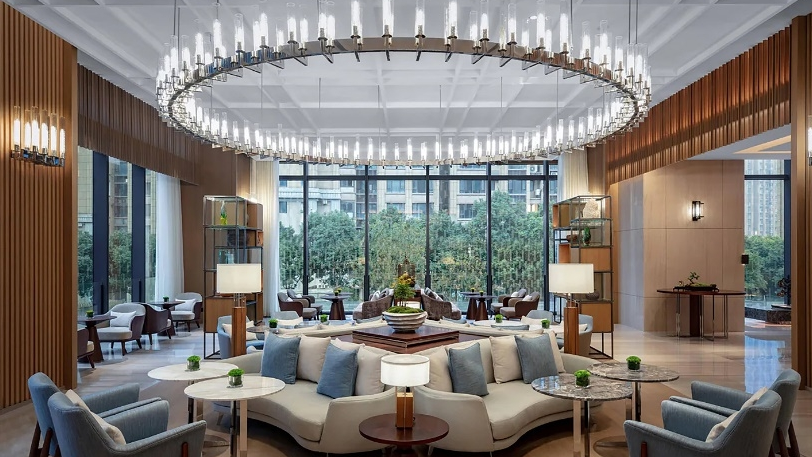
Custom hospitality products are the made-to-order pieces, from case goods and millwork to loose seating, lighting, and accessories, that a property uses to make its brand read clearly to a guest. They are not the only thing the property buys, and they are not always the most expensive line item, but they are the line item the guest actually feels. This guide walks through what custom hospitality products can really do for a property brand, where the return shows up, and how to think about scope so the program does more than fill a room.
BOTTOM LINE
Custom hospitality products are how a property turns a room, a lobby, a restaurant, or a pool deck into the brand. When the products are drawn for the property, the brand reads as intentional. When the products are pulled from a generic catalog, the brand reads as average, no matter how good the marketing is.
What Counts as a "Custom Hospitality Product"
The phrase "custom hospitality products" is sometimes used as a synonym for custom furniture, but it is actually broader. A custom hospitality product is anything the property places in a guest-facing or staff-facing space that has been designed or specified for that specific property. It can be a headboard, a credenza, a lounge chair, a bar stool, a reception desk, a pool cabana, a lighting fixture, or even a coordinated accessory line. What makes it "custom" is the same thing in every case: the product is drawn to the property's spec, not pulled from a shared catalog.
I find it useful to break custom hospitality products into three layers, because the conversation with the factory is different at each layer and the brand impact is also different.
- The case goods layer. Headboards, nightstands, desks, credenzas, dressers, minibar cabinets, and TV panels. These are the pieces the guest touches and the pieces that anchor the room's brand point of view.
- The seating and surface layer. Lounge chairs, dining chairs, bar stools, sofas, coffee tables, side tables, and benches. These are the pieces the guest uses, and they are the pieces that have to combine comfort with brand language.
- The millwork and feature layer. Reception desks, bar fronts, headboard walls, wardrobes, integrated lighting, and signature feature pieces. These are the pieces that turn a space into a destination, and they are usually the most expensive and the most visible.
Most properties do not need to go custom on all three layers. The smart move is to pick the layer where the brand has the most to gain and concentrate the custom program there, while sourcing the rest from a coordinated, vetted catalog line.
What Custom Hospitality Products Do for the Brand
The most direct thing custom hospitality products do is make the brand visible in three dimensions. The guest cannot read a press release while walking to the elevator, but they can read a headboard, a credenza, a bar front, or a lobby millwork piece. When those pieces are drawn for the property, the brand has a physical presence in the room, and the room carries the brand forward into the guest's memory in a way that no marketing channel can replicate.
Brand Visibility in Every Public Space
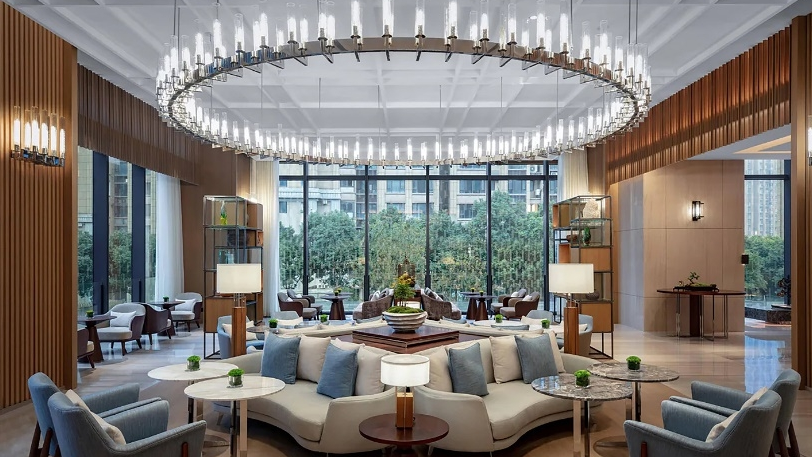
The lobby, the bar, the restaurant, the breakfast room, the pool deck, the spa reception, and the ballroom are the spaces where the property is most "on stage." Custom hospitality products let each of these spaces carry a piece of the brand that the guest can see, touch, and remember. A well-run custom program can turn a generic lobby into the property's most photographed room, simply because the millwork and the seating are drawn to the brand rather than to a shared template.
A Consistent Story Across Every Property
For multi-property operators, custom hospitality products are how the brand story stays consistent without becoming identical. The same design language is applied at each property, but the dimensions, the millwork, the local material accents, and the operating environment are tuned to the building. The brand feels like a system, and each property feels like its own place. You can see that approach in our Richart hospitality furniture overview, where the same design language is applied to a wide range of property types and operating environments.
A Documented Standard for the Long Run
A custom hospitality products program generates a full drawing set, a finish schedule, a hardware schedule, and a materials spec. Years later, when the property needs a phase-two refresh, that documentation is what makes it possible to replace, reproduce, or evolve the program without starting from scratch. It is a long-term brand asset, not a one-time order.
Where the Return on Custom Hospitality Products Shows Up
Buyers often ask how to defend the custom hospitality products budget in front of an ownership group or a brand committee. The honest answer is that the return is not always in one line of the P&L. It shows up across several, and the strongest cases I have built have framed it that way.
WHERE CUSTOM HOSPITALITY PRODUCTS EARN THEIR RETURN
- Higher ADR and RevPAR at properties that can defend a premium positioning
- Lower lifetime operating cost because pieces last longer and need fewer field fixes
- Stronger online reputation because the property photographs better and the rooms feel intentional
- Faster, cheaper future refreshes because the spec is documented and reproducible
None of those returns are guaranteed by simply spending more on custom. They come from a custom program that is well specified, well sampled, well produced, and well installed. The brand return is the cumulative result of doing all of those steps well, and it is exactly why a custom hospitality products program has to be run as a small project, not a one-off purchase.
How to Scope a Custom Hospitality Products Program
If you have decided to invest in custom hospitality products, the next move is to scope the program in a way that keeps it focused. The most successful custom programs I have worked on all started with the same three scoping questions, and I have yet to see a case where they were the wrong place to start.
- Which spaces are doing the most brand work, and therefore deserve the most custom product investment
- Which pieces in those spaces have to be drawn for the property, and which can be sourced from a coordinated catalog line
- What performance targets each space requires, from contract-grade fabric to outdoor-rated finishes to acoustic performance
Once those three questions are answered, the rest of the program falls into place. The brief is clearer, the supplier conversation is more focused, and the sample plan is easier to scope. A custom hospitality products program that starts this way almost always runs more smoothly than one that starts with a catalog download and a wish list.
Choosing a Partner Who Can Deliver Custom Hospitality Products
The final piece of the puzzle is the partner. Not every supplier who says they offer custom hospitality products is actually equipped to deliver them, and the difference shows up in three places: the in-house design team, the sample-first workflow, and the quality system behind the production run. A partner with all three is a partner who can handle the program. A partner with only one or two is a partner who will end up costing more than they save.
When you evaluate potential partners, ask the same set of questions each time and compare the answers. The partner who can show an in-house R&D team, a real first-article sample from a recent program, current ISO 9001 and ISO 14001 certifications, and reference projects at the right tier is the partner worth your short list. The rest are worth a polite pass.
Frequently Asked Questions About Custom Hospitality Products
What is the difference between custom hospitality products and custom hotel furniture?
Custom hotel furniture focuses on guest room and public space furniture. Custom hospitality products is the broader term that includes furniture plus accessories, lighting, and other made-to-order pieces that carry the brand.
Do I have to go custom on every piece in the property?
No. The strongest custom hospitality products programs concentrate the custom investment in the rooms and public spaces where the brand has the most to gain, and use a coordinated catalog line for the rest. The two should look like the same family, not two different properties.
How long does a custom hospitality products program take?
A typical full-property program runs from a few weeks for a single signature piece to several months for a multi-room or multi-space rollout. The exact timeline depends on the scope and the complexity of the millwork.
Is a custom hospitality products program only for luxury properties?
Not at all. The same logic applies to any property that wants the brand to read clearly. The scope is what changes, not the principle. A focused-service property can run a tight, well-chosen custom program on a smaller set of high-impact pieces.
If you are weighing a custom hospitality products program for your property, our team can help you scope the brief, walk through reference projects, and put together a sample plan around your brand direction.